Skip to content

Edge ML Vision Pipeline

NVIDIA Jetson Nano edge AI configuration, real-time CNN weed detection benchmarks, camera stabilization, and signal wiring integration.

This document summarizes the edge machine learning (ML) pipeline benchmarks, hardware-software configurations, and chassis electrical integration setup of the Smart Agri Four Legged Bot.


1. Embedded Compute & Vision Configuration

Section titled “1. Embedded Compute & Vision Configuration”

The machine learning system is deployed directly at the edge to enable real-time detection without depending on cloud processing.
flowchart LR RealSense["Intel RealSense D435"] -->|USB 3.0 RGB-D| Jetson["NVIDIA Jetson Nano<br>Ubuntu 18.04 + PyTorch"] Jetson -->|UART Commands| Arduino["Arduino Due<br>Low-Level Control"] AmiciProbe["Amici Sense Soil Probe"] -->|UART Serial Telemetry| Jetson Jetson -->|Logging| CSV["Local Data Log CSV"]
  • Central Processor: NVIDIA Jetson Nano running Ubuntu 18.04 LTS (JetPack SDK)
  • Deep Learning Backend: PyTorch
  • Primary Perception Sensor: Intel RealSense D435 depth camera
    • Data Channels: RGB frames fused with Active Infrared Stereo depth maps
    • Interface: USB 3.0
    • Mounting Alignment: Centered on chassis axis, pitched downward at 10° (optimized from 15° to cover near-field crop zone between the front wheels)
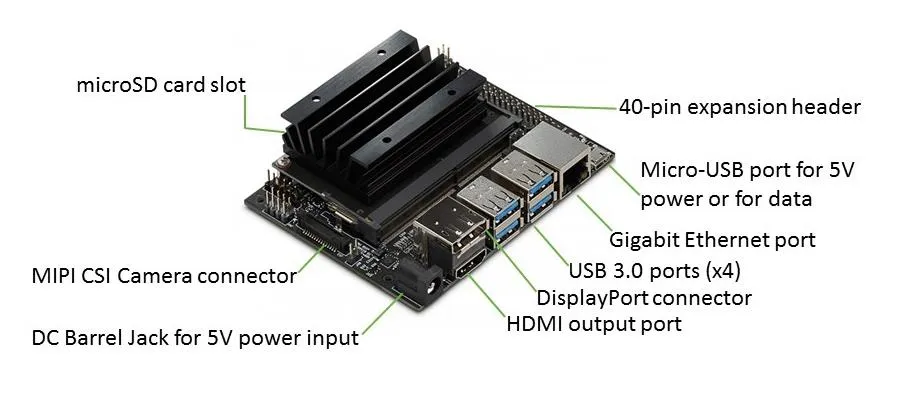
NVIDIA Jetson Nano core single board computer
NVIDIA Jetson Nano SBC
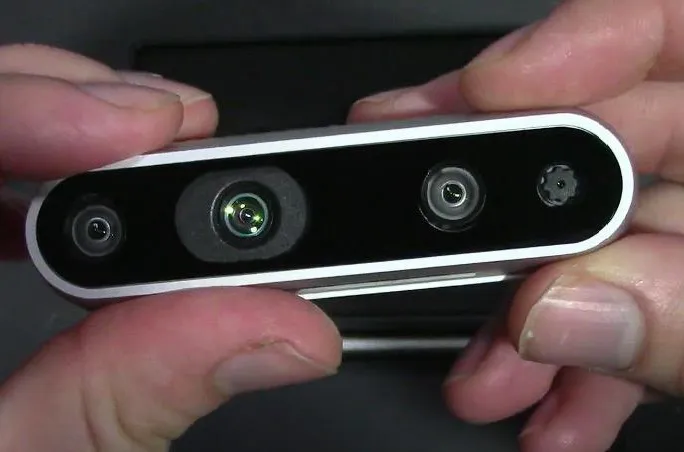
Intel RealSense D435 perception camera module
Intel RealSense D435 Camera

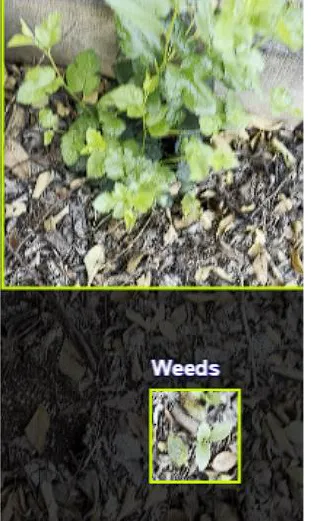
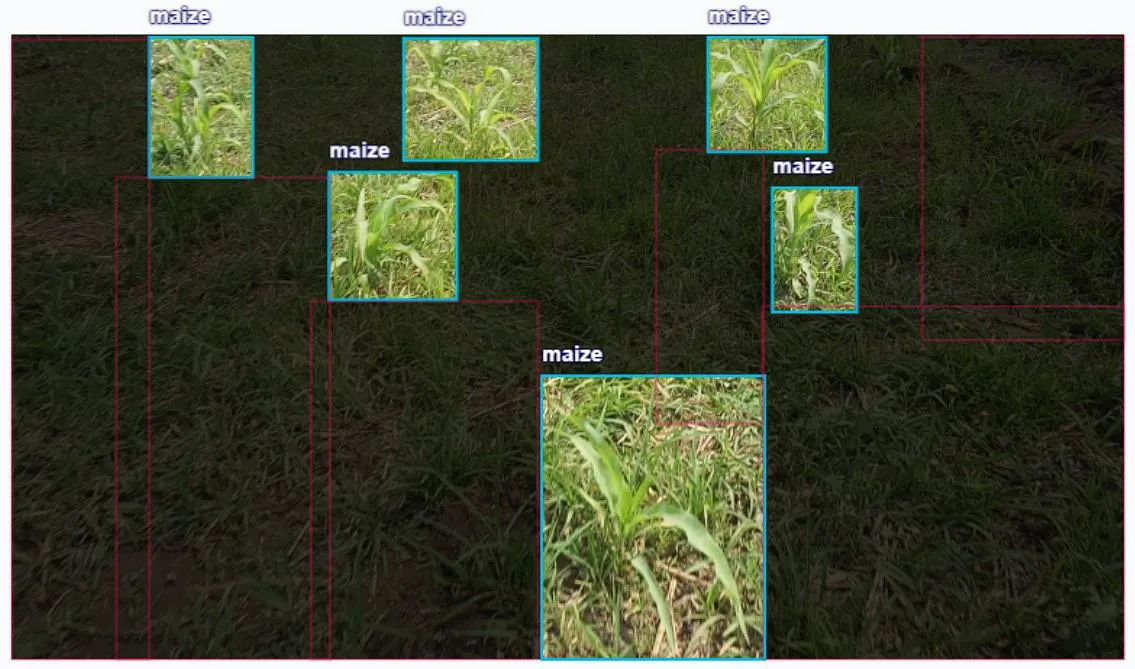
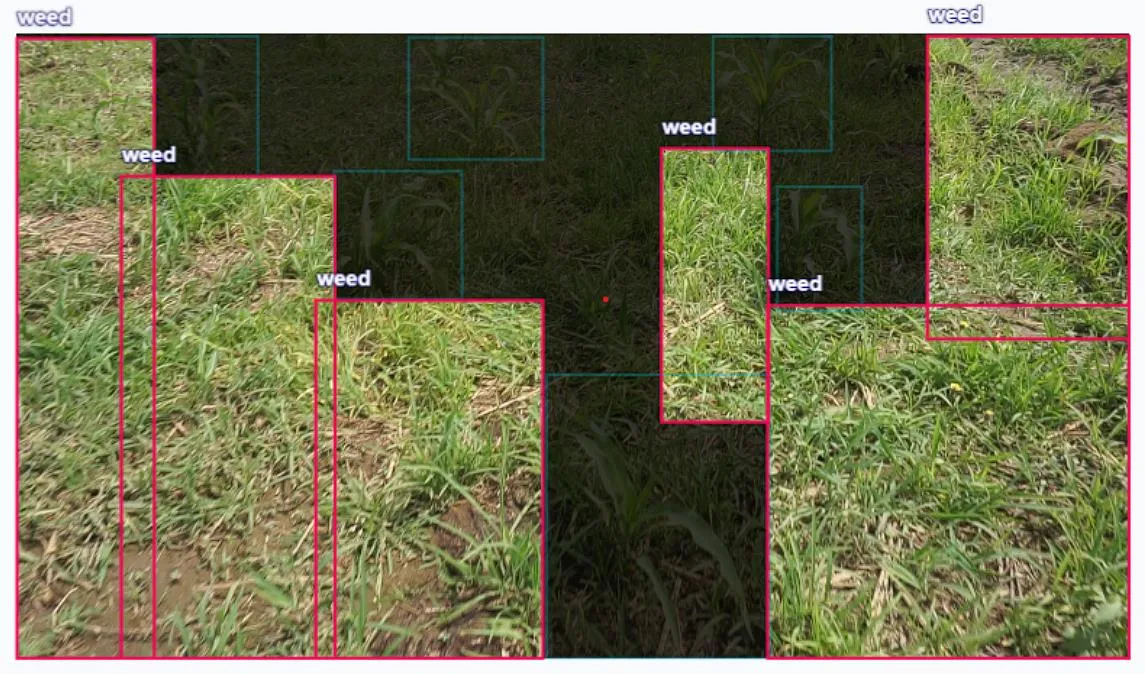
The weed detection task uses a lightweight Convolutional Neural Network (CNN) trained to identify broad-leaf weed clusters around maize crops.

Performance MetricBenchmarked ValueEnvironment
Input Image Resolution640 × 480 pixelsOutdoor RGB-D
Average Inference Latency135 ms per frameOver 5-frame average
Static Pipeline Frame Rate9.2 FPSBenchmarked stationary
In-Field Traversal Frame Rate5.0 FPSUnder continuous motion
Detection Accuracy>88.0%Broad-leaf weed cluster classification
Power Consumption9.6 W (Peak)Jetson Nano + RealSense Camera active
Real-time weed detection and bounding boxes

To prevent camera shake from causing image blur and ML misclassifications, the robot uses a dual mechanical-software stabilization strategy:

Vibration Isolators

Integrated rubber washers on all camera bracket bolt threads to absorb high-frequency chassis rattle.

Damping Spacers

High-density foam inserts situated underneath the battery pack and Jetson base plate to dampen low-frequency bumps.

Balance Counterweights

Geometrically balanced motor shaft mounts to minimize rotational resonance during locomotion.

RealSense Frame Averaging

Averages consecutive depth frames to eliminate high-frequency visual and depth noise.

Confidence Filtering

Computes a 3-frame rolling average before confirming and executing weed bounding box triggers.

Sensor Telemetry Sync

Halts locomotion motors during soil probe insertion to completely eliminate vibration noise during telemetry transmission.


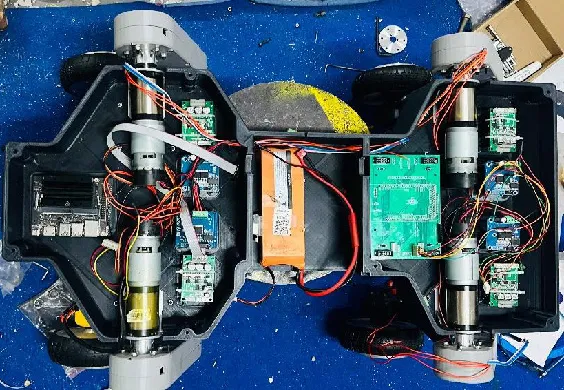
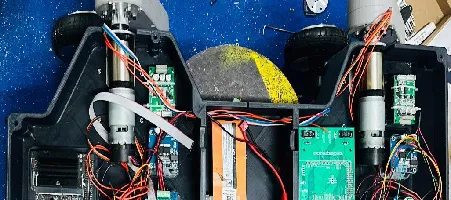
A structured electrical base plate separates signal lines and motor supplies.
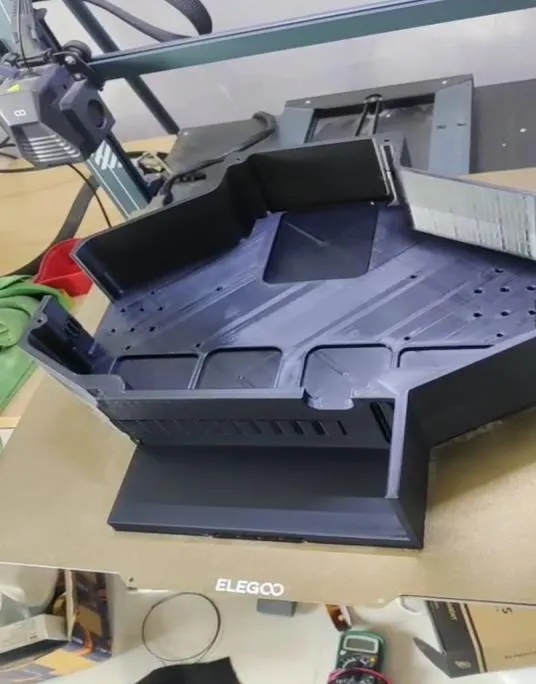
PLA component mounting base plate
PLA Component Mounting Base Plate
Power supply and switching circuits inside chassis
Internal Power & Switching Layout
Top-down view of wire layout with fasteners
Top-Down Cable Routing Layout
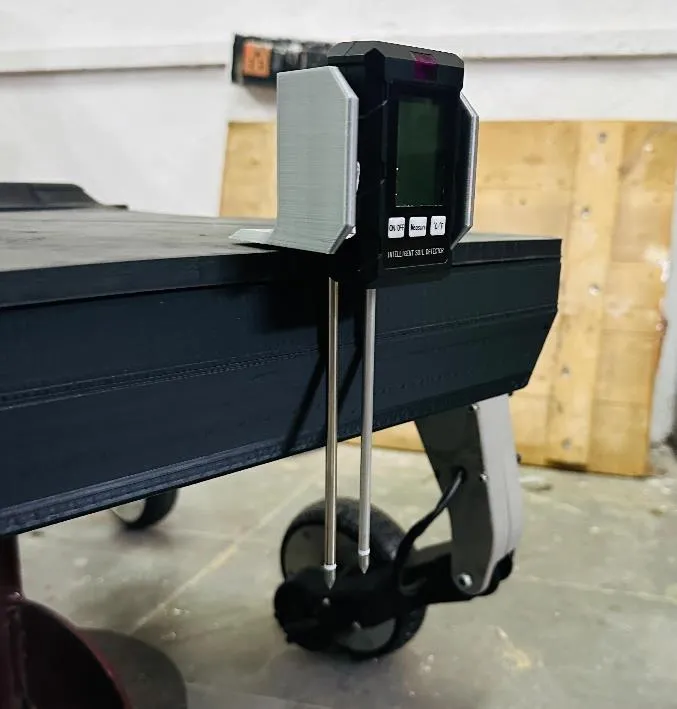
Rear mount installation for Amici probe
Rear Probe Mounting Position

Actuation & Low-Level Control Architecture

Section titled “Actuation & Low-Level Control Architecture”

Precise and coordinated joint movements are managed using a dual-controller layout:

  • Low-Level Controller: An Arduino Due acts as the dedicated real-time actuator controller (84 MHz clock frequency, 12 hardware PWM outputs, and multiple hardware serial UART interfaces).
  • High-Level Interface: Commands are received from the NVIDIA Jetson Nano over a dedicated serial connection running at 115,200 baud. The Arduino Due parses these motion paths and translates them into PWM commands.
  • Actuators & Drivers:
    • Geared DC Motors: Four planetary geared units for shoulder articulation (driven via dual H-bridge motor drivers).
    • Brushless Hub Motors: Two distal direct-drive hub motors (driven via high-current Electronic Speed Controllers or ESCs) provide primary locomotion.

To prevent motor current draws from causing brownouts or logic resets on the Jetson Nano, power rails are split:

  • Logic Rail: 5V rail stepped down from the main 24V bus via a DC-DC buck converter to supply the Jetson Nano, camera, and sensors.
  • Geared Motor Rail: A regulated 12V supply bus managed by the H-bridge drivers for shoulder articulation.
  • Locomotion Motor Rail: A direct 24V high-current bus from the battery pack to the ESCs for the hub wheels.

To prevent electromagnetic interference (EMI) from the high-torque actuators from corrupting the low-voltage sensor lines:

  • Perimeter Routing: High-current motor lines are routed strictly along the outer edges of the chassis frame.
  • Central Data Channels: Low-voltage signal lines are elevated and routed centrally.
  • Ferrite Suppression: Ferrite beads are added to motor cable pairs, and all motor logic wires are shielded and grounded to establish common reference planes.