Skip to content

Institutional Credentials

Academic and institutional details, student team, guides, and college credentials.

This section details the academic oversight, student team composition, institutional credentials, and supervisory approval metadata associated with the development of the Smart Agri Four Legged Bot (2024-2025).


MetricDetail
InstitutionMuffakham Jah College of Engineering and Technology (MJCET)
LocationBanjara Hills, Hyderabad - 500034, Telangana, India
AffiliationAffiliated to Osmania University, Hyderabad
Approvals & AccreditationsApproved by AICTE, Accredited by NBA
Academic DivisionDepartment of Mechanical Engineering (MED)
Research ContextResearch and Development Cell (R&D) Project Completion Report
Academic ProgramBachelor of Engineering in Mechanical Engineering
Academic Year2024–2025

The project was carried out under the direct guidance, review, and administrative support of the following faculty members:

graph TD Principal["Dr. Mahipal Singh Rawat<br><b>Principal, MJCET</b>"] HOD["Dr. Md. Viquar Mohiuddin<br><b>Head of Department, MED</b>"] Coordinator["Prof. Dr. Ishrat Meera Mirzana<br><b>Associate Head & R&D Cell Coordinator</b>"] Supervisor["Dr. K. Hema Latha<br><b>Project Supervisor & Associate Professor, MED</b>"] Principal --> HOD HOD --> Coordinator HOD --> Supervisor

Dr. K. Hema Latha

Project Supervisor
Associate Professor, Department of Mechanical Engineering (MED), MJCET.

Dr. Md. Viquar Mohiuddin

Head of Department (MED)
Professor and Head, Department of Mechanical Engineering (MED), MJCET.

Prof. Dr. Ishrat Meera Mirzana

Project & R&D Coordinator
Associate Head & R&D Cell Coordinator, MJCET.

Dr. Mahipal Singh Rawat

Institutional Leadership
Principal, MJCET.


Below is the list of undergraduate engineering students who designed, simulated, fabricated, and tested the robotic system:

Syed Murtaza Ahmed

  • Hall Ticket: 1604-24-736-017
  • Program: Mechanical Engineering
  • Role & Contributions: Principal System Architect. Led end-to-end electrical design, control software development, and edge ML pipeline integration.

Mohammed Zainul Abedin Kaleemi

  • Hall Ticket: 1604-24-736-041
  • Program: Mechanical Engineering
  • Role & Contributions: CAD & Mechanical Coordinator. Handled SolidWorks design layout, frame detailing, and acted as the primary team-to-faculty liaison.

Mohammed Muzzammil

  • Hall Ticket: 1604-24-736-039
  • Program: Mechanical Engineering
  • Role & Contributions: CAD & Assembly Design. Handled mechanical modeling, component alignment checks, and physical assembly layout integration.

Mohammed Qubaib

  • Hall Ticket: 1604-24-735-026
  • Program: Electronics & Communication Engineering
  • Role & Contributions: Electrical System & Logistics. Managed electrical harness routing, sensor serial calibration, and materials procurement operations.

Syed Faisal

  • Hall Ticket: 1604-24-736-029
  • Program: Mechanical Engineering
  • Role & Contributions: Fabrication & Field Operations. Led hands-on steel chassis fabrication, structural operations, and transportation logistics.

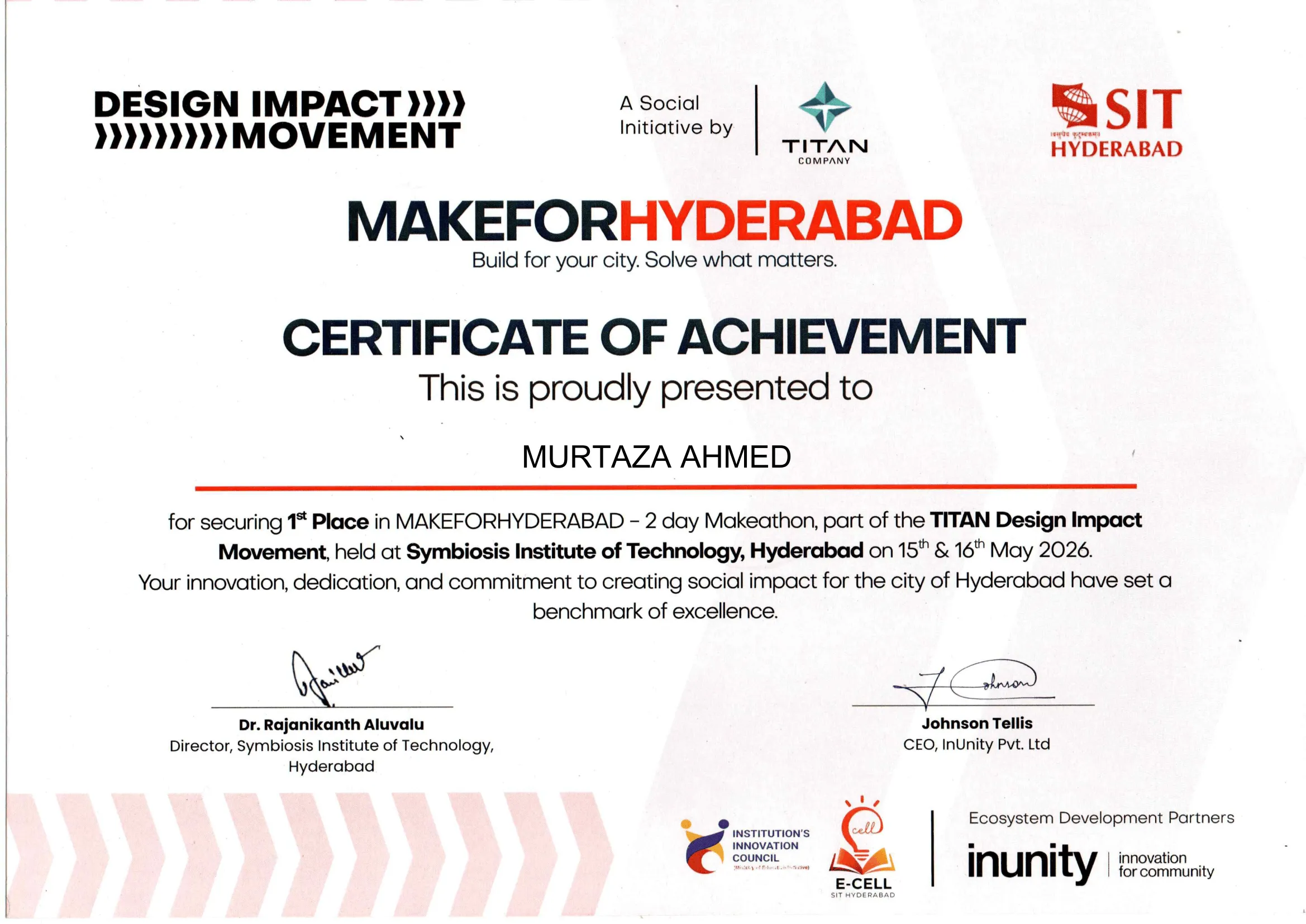
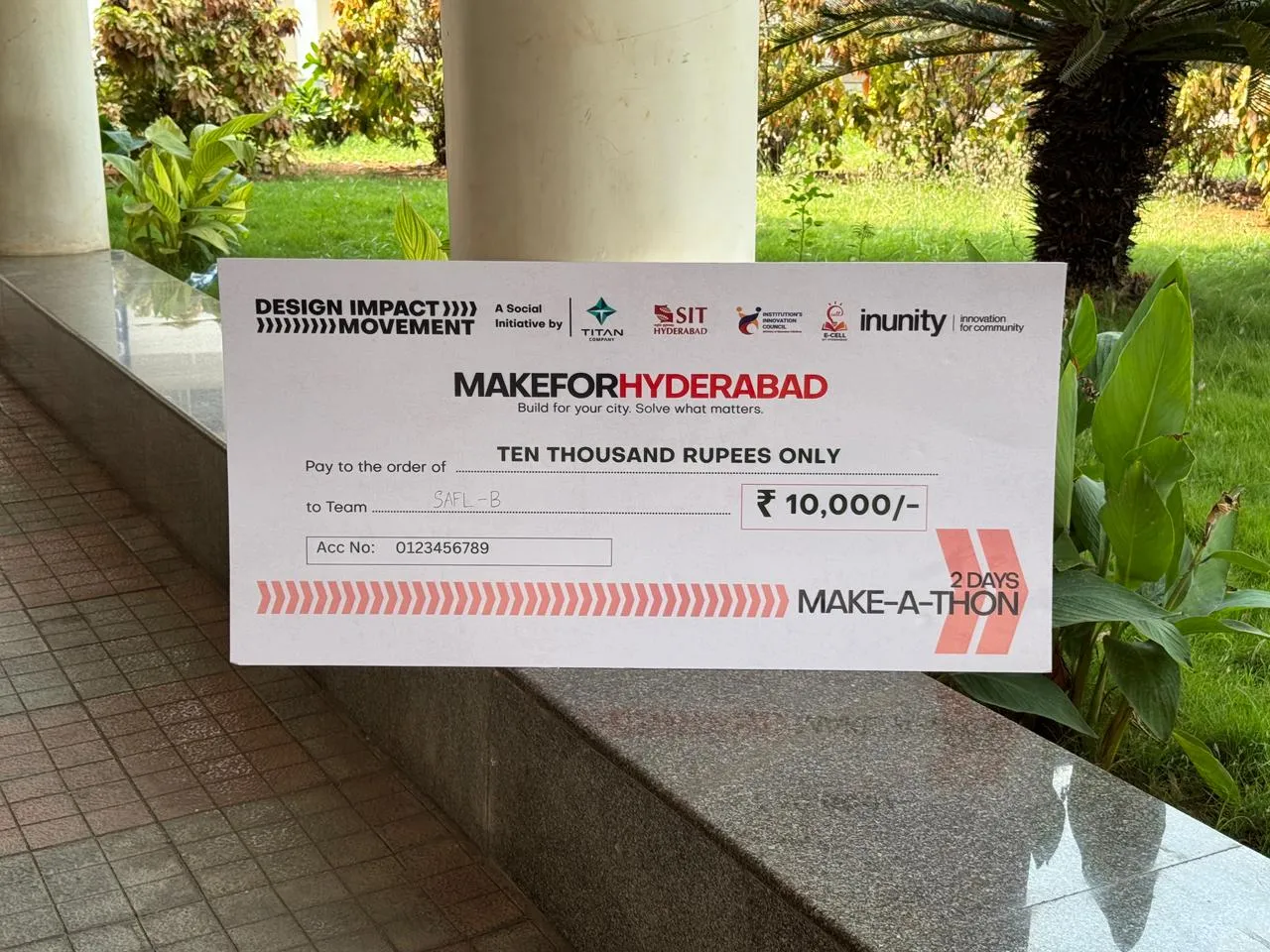
The Smart Agri Four Legged Bot (Team SAFL-B) was entered into the city-wide MAKEFORHYDERABAD 2-Day Make-a-thon competition on 15th & 16th May 2026 (held at Symbiosis Institute of Technology, Hyderabad). The event was organized as a Titan Design Impact Movement social initiative by Titan Company, Symbiosis Institute of Technology (SIT), and InUnity Pvt. Ltd.

  • Achievement: 1st Place Winner
  • Prize Awarded: ₹10,000 Cash Prize to Team SAFL-B.
Murtaza Ahmed 1st Place Certificate
Hackathon 1st Place Certificate — Murtaza Ahmed
MAKEFORHYDERABAD ₹10,000 Cash Check
Cash Prize Check — ₹10,000 awarded to Team SAFL-B

The project followed a structured lifecycle from concept and requirement analysis to field testing:

Phase 1: Mechanical Design & Chassis Fabrication (Nov 2024 – May 2025)

Section titled “Phase 1: Mechanical Design & Chassis Fabrication (Nov 2024 – May 2025)”
  1. Stage A: Requirements Setup (November 2024): Problem identification, literature review, field interviews, and project parameter definition.
  2. Stage B: CAD Modeling & Mechanical Simulation (December 2024 – January 2025): SolidWorks design of the wheeled-leg assemblies and Finite Element Analysis (FEA) for stress and deflection.
  3. Stage C: Frame Fabrication & Assembly (February 2025 – May 2025): Steel plate laser cutting, chassis welding, and FDM 3D printing of custom brackets and component enclosures.

Phase 2: Hardware Integration, Prototyping & Field Validation (Sept 2025 – May 2026)

Section titled “Phase 2: Hardware Integration, Prototyping & Field Validation (Sept 2025 – May 2026)”
  1. Stage A: Hardware & ML Integration (September 2025 – October 2025): Sensor harness routing, Jetson Nano setup, power distribution wiring, and local CNN classification model deployment.
  2. Stage B: Field Testing & Academic Submission (November 2025): Initial terrain traversal verification, compilation of final project report, and successful academic review board presentation.
  3. Stage C: System Ruggedization & Optimization (December 2025 – February 2026): Improving wiring harness layout, installing physical vibration isolators, upgrading voltage regulation, calibrating soil probe telemetry, and expanding regional weed datasets.
  4. Stage D: Traversal Testing & Navigation Control (March 2026 – April 2026): Testing semi-autonomous traversal on uneven agricultural soil and verifying manual controller overrides.
  5. Stage E: Competition Validation & Award (May 2026): Live field validation trials at the city-wide MAKEFORHYDERABAD Make-a-thon, winning 1st Place (Cash Prize ₹10,000) for a field-ready agricultural rover.

Relevance to Environment, Safety, & Ethics (Appendix II)

Section titled “Relevance to Environment, Safety, & Ethics (Appendix II)”

The project contributions were evaluated against the standard National Board of Accreditation (NBA) Program Outcomes (PO1 to PO12):

(Mapping scale: 3 = Highly Relevant, 2 = Moderately Relevant, 1 = Less Relevant)

  • PO1: Engineering Knowledge (Mapping: 3)
    • Contribution: Applied mechanical design, electronics integration, and edge ML principles to solve real-world agricultural automation challenges.
  • PO2: Problem Analysis (Mapping: 3)
    • Contribution: Analyzed field requirements and translated them into specific mechanical, electrical, and software specifications.
  • PO3: Design/Development of Solutions (Mapping: 3)
    • Contribution: Engineered a modular, stable, and terrain-adaptable quadruped wheeled robot chassis addressing specific farming needs.
  • PO4: Conduct Investigations of Complex Problems (Mapping: 2)
    • Contribution: Performed FEA-based structural stress/deflection simulations and validated them against physical field data.
  • PO5: Modern Tool Usage (Mapping: 3)
    • Contribution: Utilized CAD (SolidWorks), FEA (SolidWorks Simulation), edge computing hardware, PyTorch ML models, and digital calipers.
  • PO6: The Engineer and Society (Mapping: 2)
    • Contribution: Aimed to address rural labor shortages and improve farm productivity, contributing positive social value.
  • PO7: Environment and Sustainability (Mapping: 3)
    • Contribution: Promotes sustainable farming practices by enabling targeted weed treatment and reducing chemical overuse in fields.
  • PO8: Ethics (Mapping: 2)
    • Contribution: Conducted testing with high regard for operator safety, electrical isolation, and verified academic integrity of research.
  • PO9: Individual and Team Work (Mapping: 3)
    • Contribution: Executed in a multidisciplinary team setting with shared tasks across mechanical fabrication, electronics design, and software.
  • PO10: Communication (Mapping: 2)
    • Contribution: Prepared design documents, technical schematics, and delivered final presentations to academic reviewers.
  • PO11: Project Management and Finance (Mapping: 2)
    • Contribution: Managed component procurement, 3D printing schedules, and assembly timelines under a limited budget.
  • PO12: Life-Long Learning (Mapping: 2)
    • Contribution: Gained hands-on cross-disciplinary engineering capabilities (edge GPU logic, CAD/FEA sync) through self-directed learning.

  • Status: Approved
  • Review Committee Approval: Completed May 2025
  • Ethics Code Compliance: Verified mapping to Program Outcomes (PO1 to PO12) with high relevance in Engineering Knowledge (PO1), Design (PO3), Modern Tool Usage (PO5), and Sustainability (PO7).