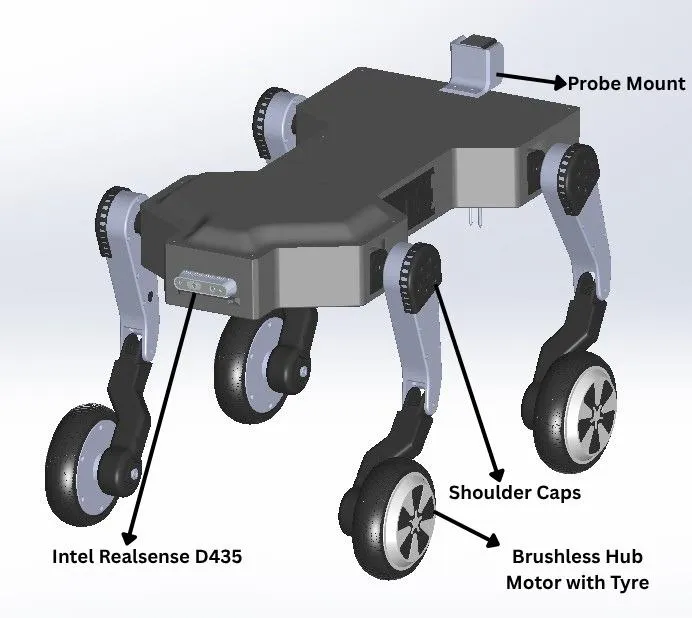
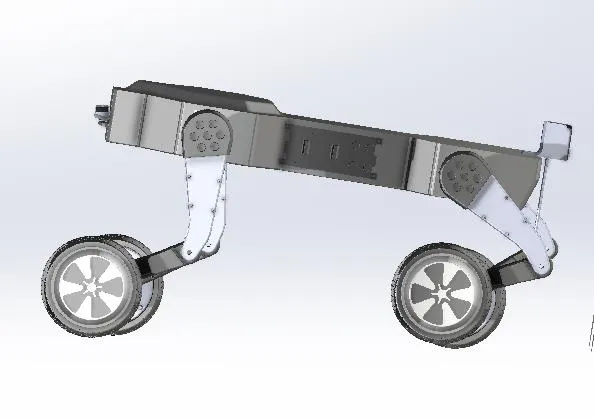
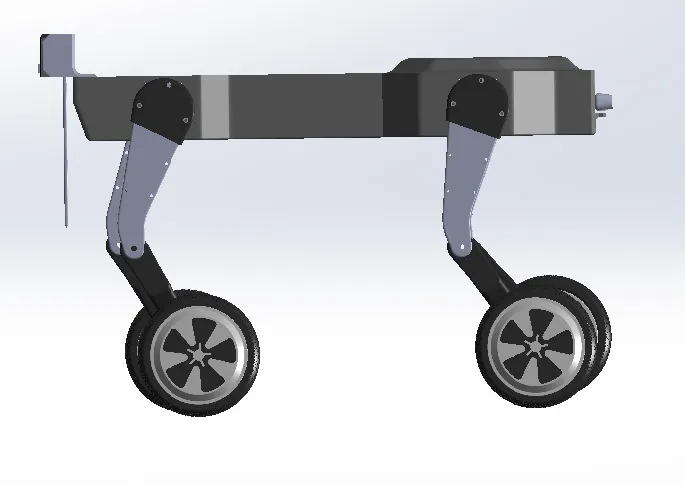
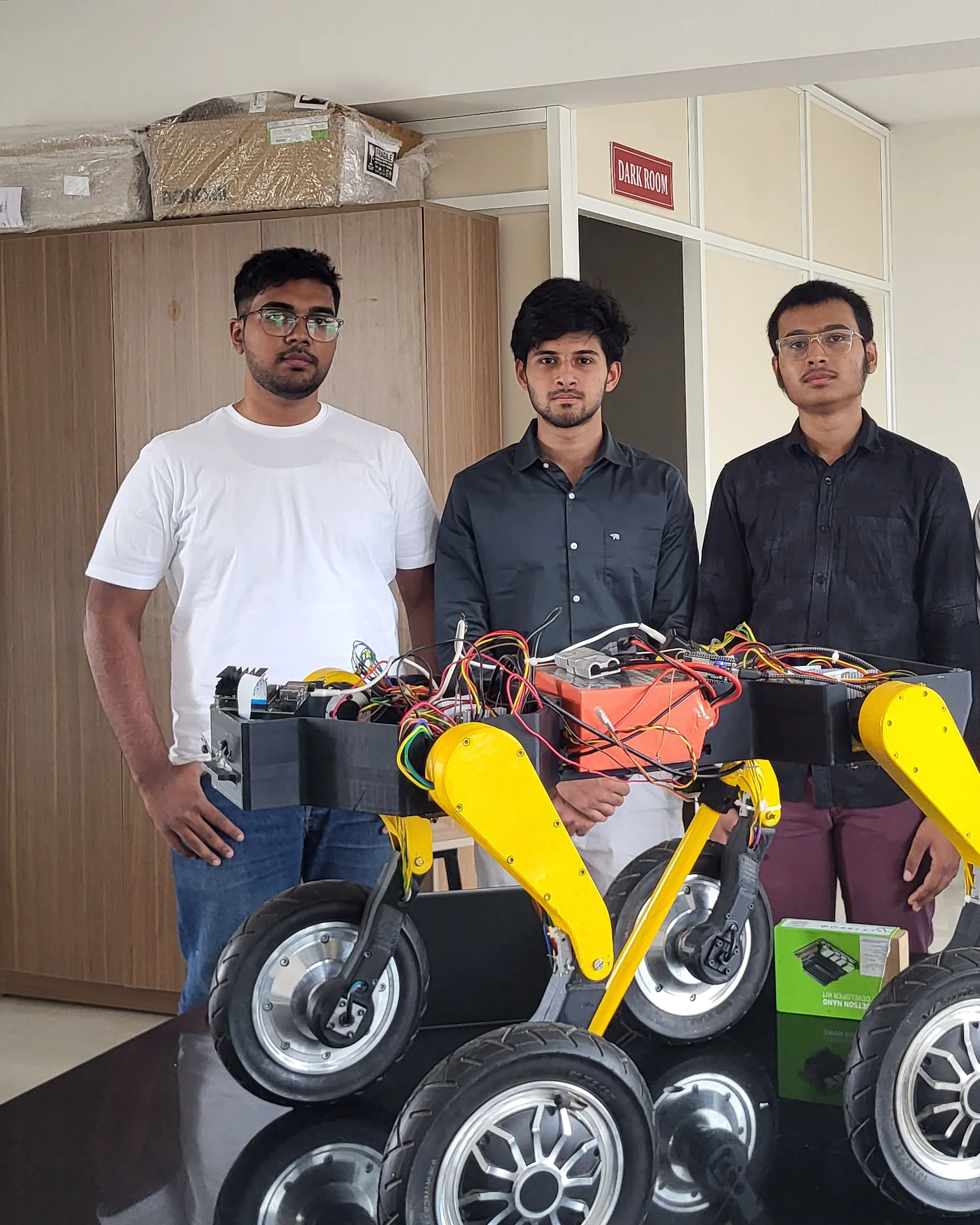
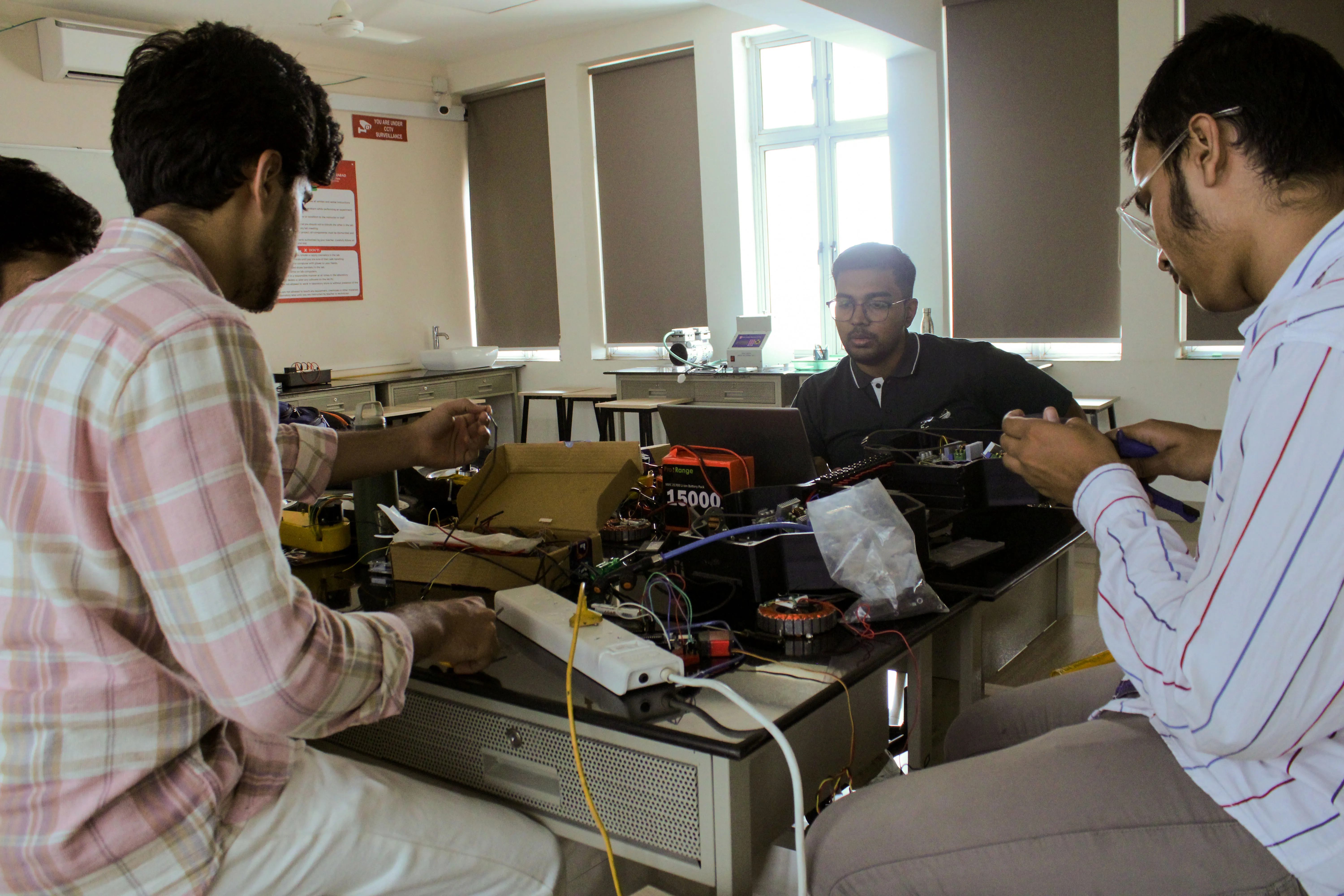
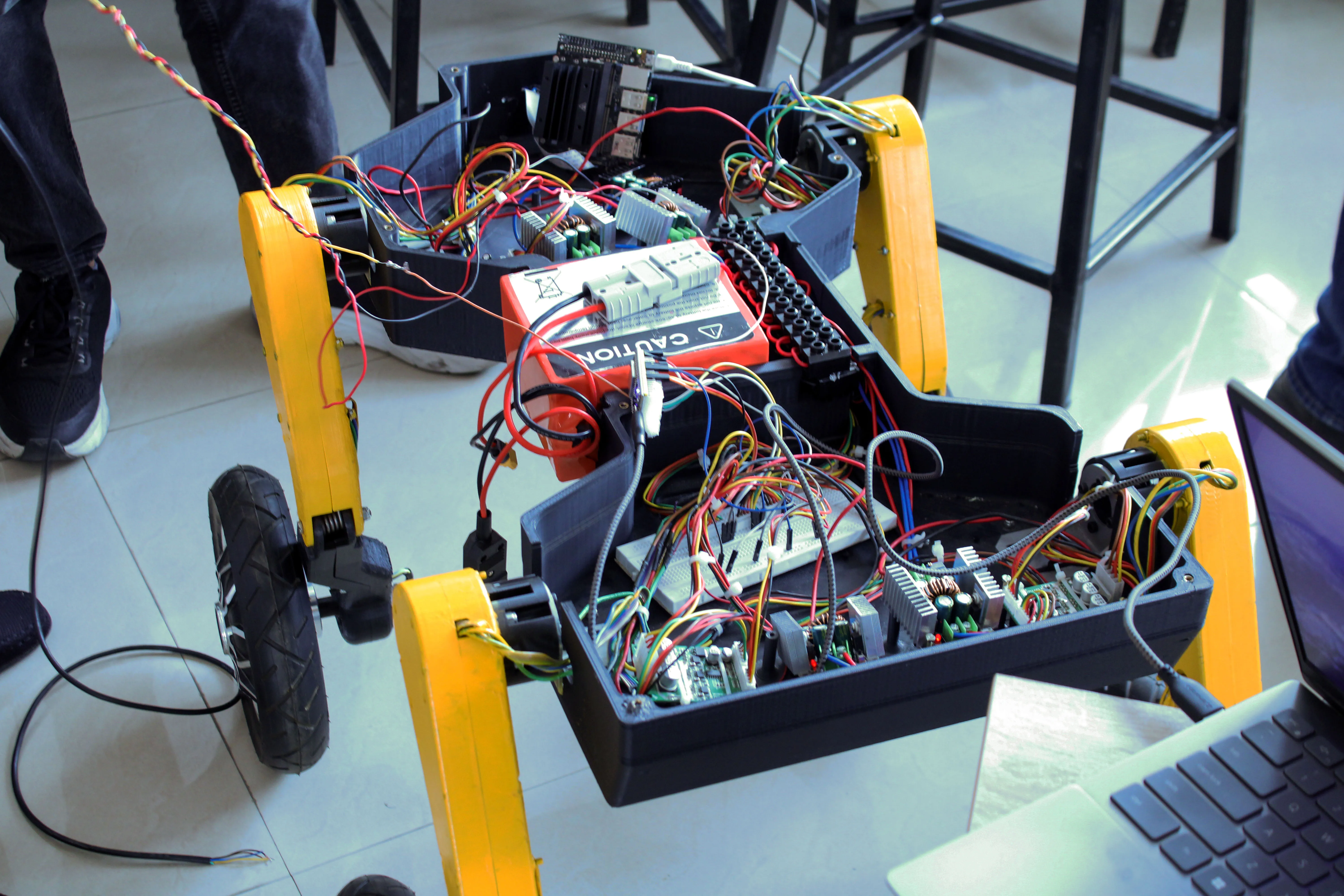
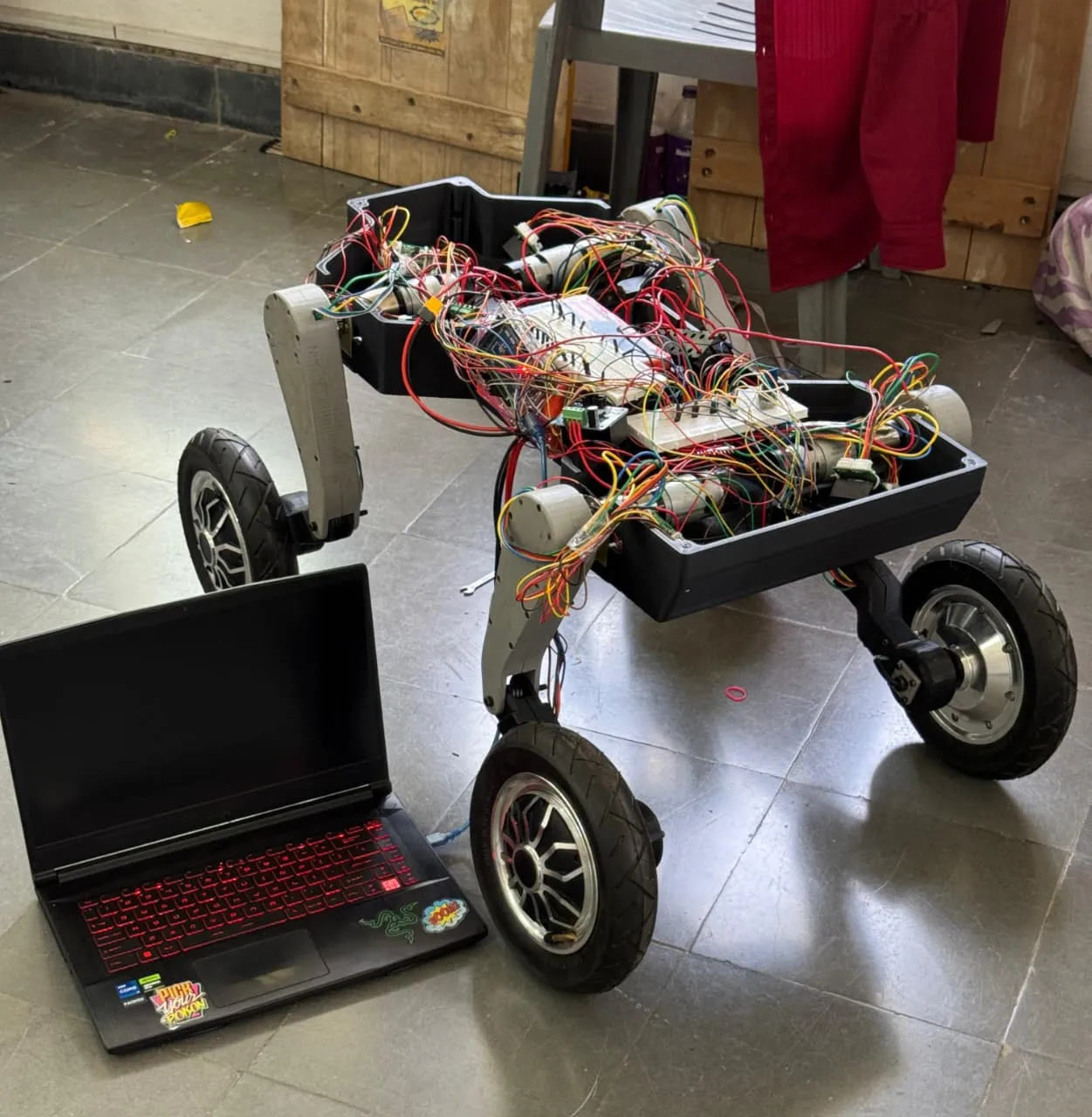
The Smart Agri Four Legged Bot is a semi-autonomous agricultural robot designed to support precision farming through automated weed detection and in-situ soil condition monitoring. The project emphasizes modularity, mechanical reliability, and ease of maintenance under real-world agricultural constraints.
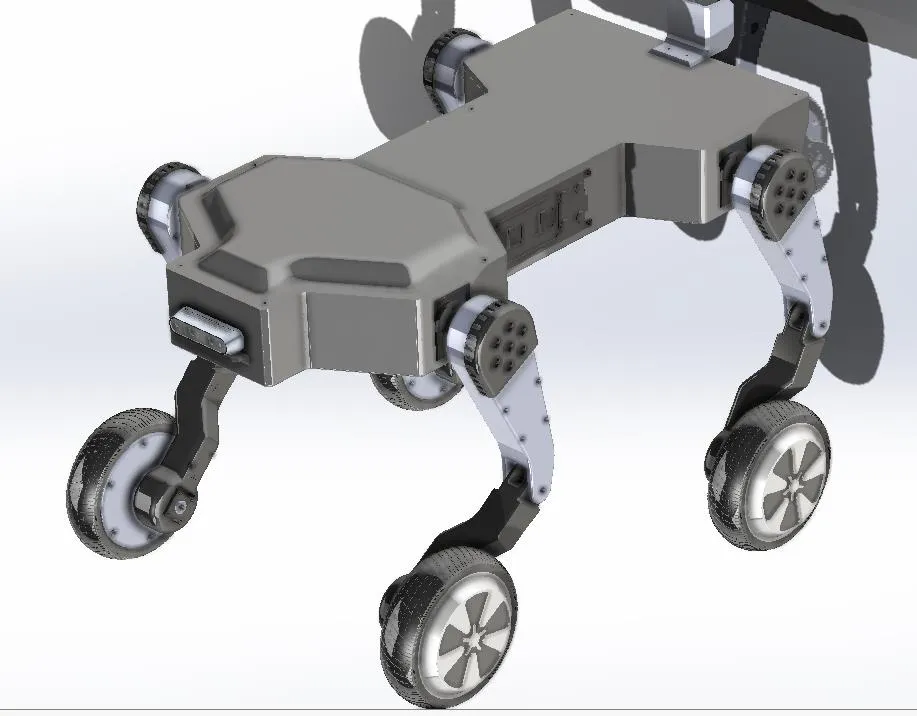
Symmetrical CAD Overview — isometric view of the complete robotTop-Left Render View — final CAD render
The robot is engineered around a hybrid fabrication approach:
Mechanical Substructure
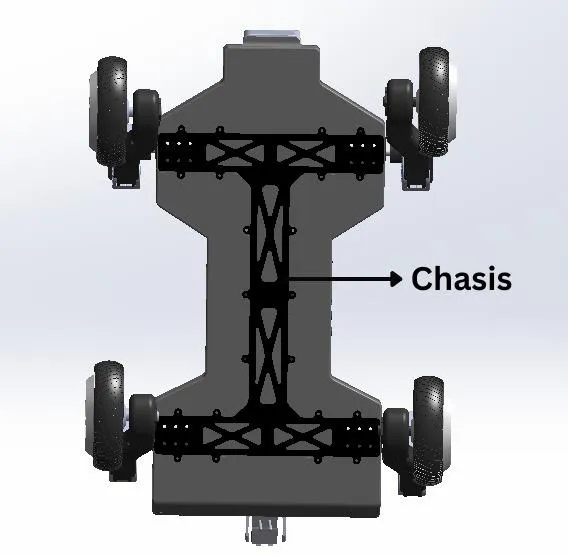
A robust, laser-cut 3mm mild steel chassis reinforced with bottom plates and connected to four articulated planar legs.
Electronics & Computing
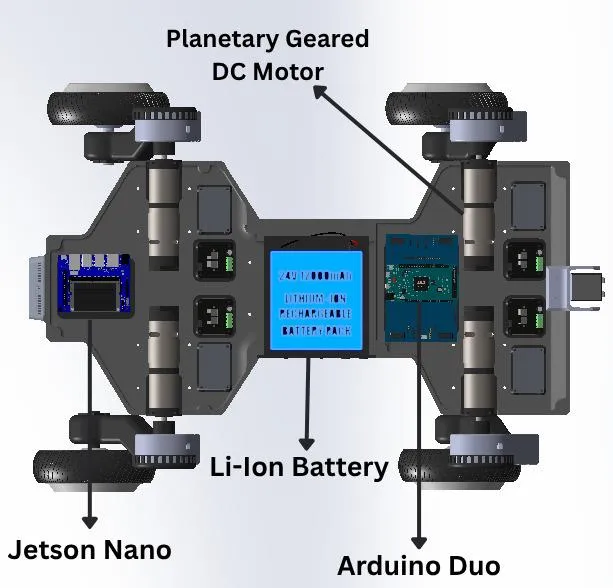
An NVIDIA Jetson Nano single-board computer acts as the central brain, handling visual input from an Intel RealSense D435 depth camera and serial telemetry from an Amici Sense soil probe.
Actuation & Low-Level Control
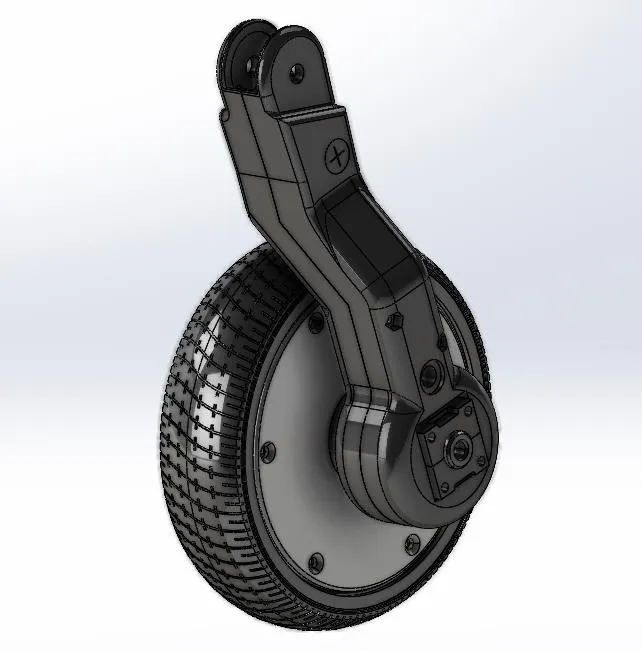
An Arduino Due manages low-level motor control, driving four planetary geared DC motors for shoulder articulation and two distal brushless hub motors for locomotion.
Terrain Adaptability: Design a mechanically stable, terrain-capable chassis optimized for uneven, sloped agricultural fields.
Structural Verification: Validate the mechanical load paths, stress limits, and deflections using Finite Element Analysis (FEA) to guarantee structural safety.
Hybrid Fabrication: Construct load-bearing structures with steel while using FDM 3D printing (PETG/PLA+) for lightweight, non-structural covers and sensor enclosures.
Vision-Based Weed Detection: Integrate a real-time ML pipeline using deep learning (lightweight CNN) for weed bounding box classification on the edge.
Precision Soil Probe: Integrate an in-ground multi-parameter sensor to measure soil health parameters without tipping or stability issues.
Resilient Electrical System: Implement EMI signal isolation, separate power rails, and robust wiring layouts to ensure continuous field operation.
The internal layout was designed to separate data processing units from high-current power electronics to minimize EMI and facilitate thermal convection.
Internal Layout Cutaway — battery pack and board placementBottom View with Stiffeners — chassis base plate reinforcement
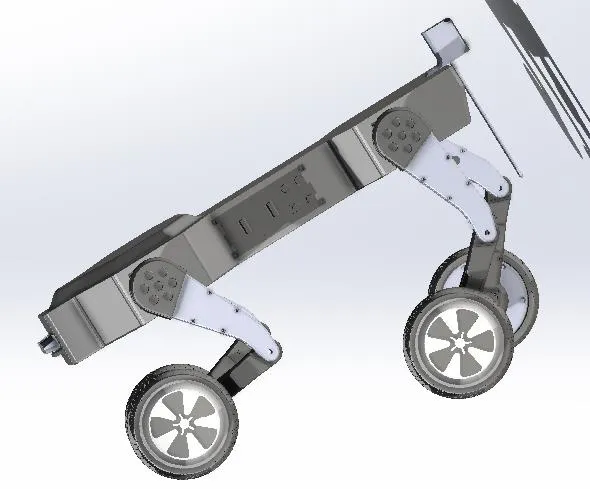
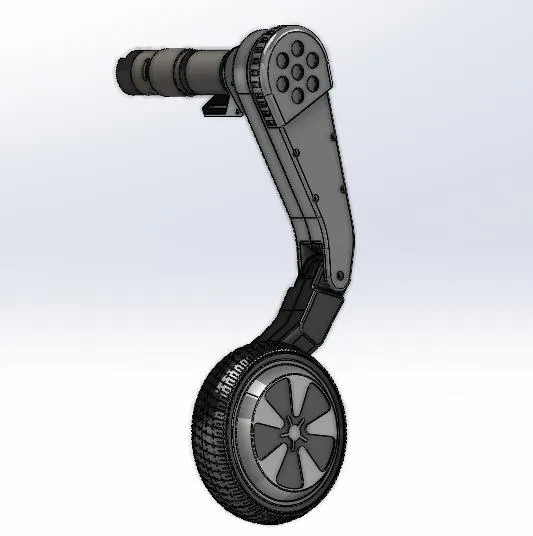
The robot’s planar legs are articulated in three segments, allowing the body to adjust its pitch and ground height to maintain vertical camera stability and traction over sloped terrain.
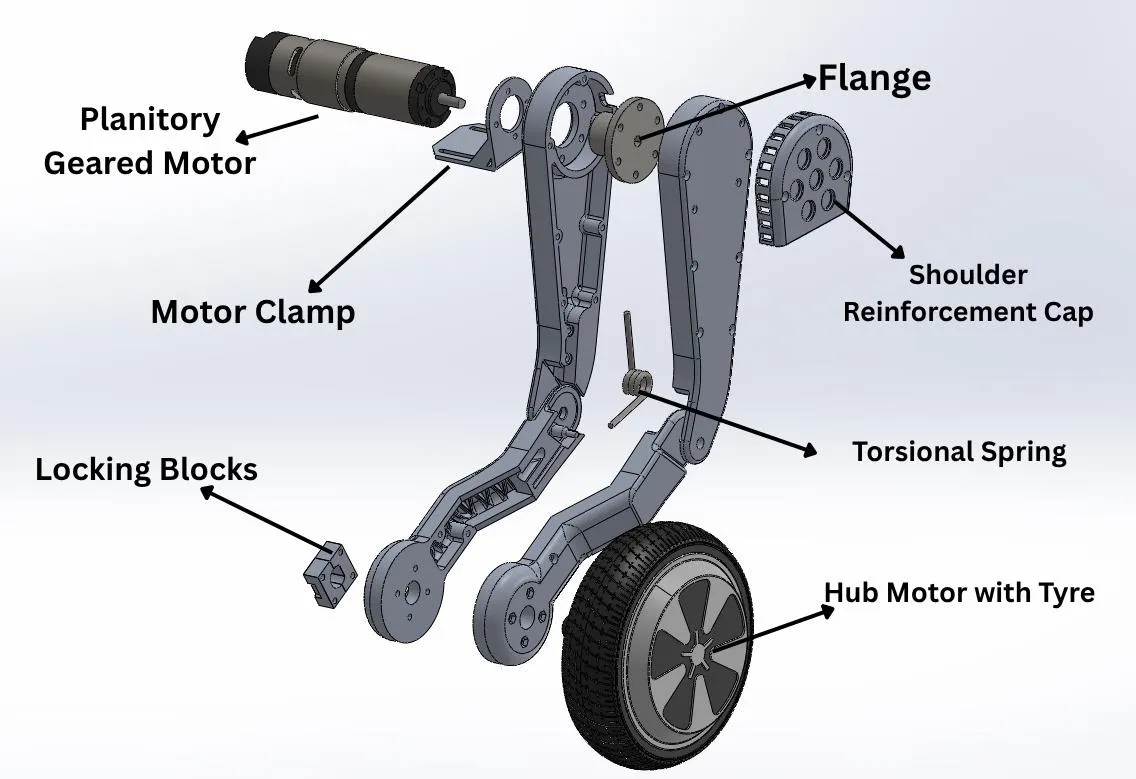
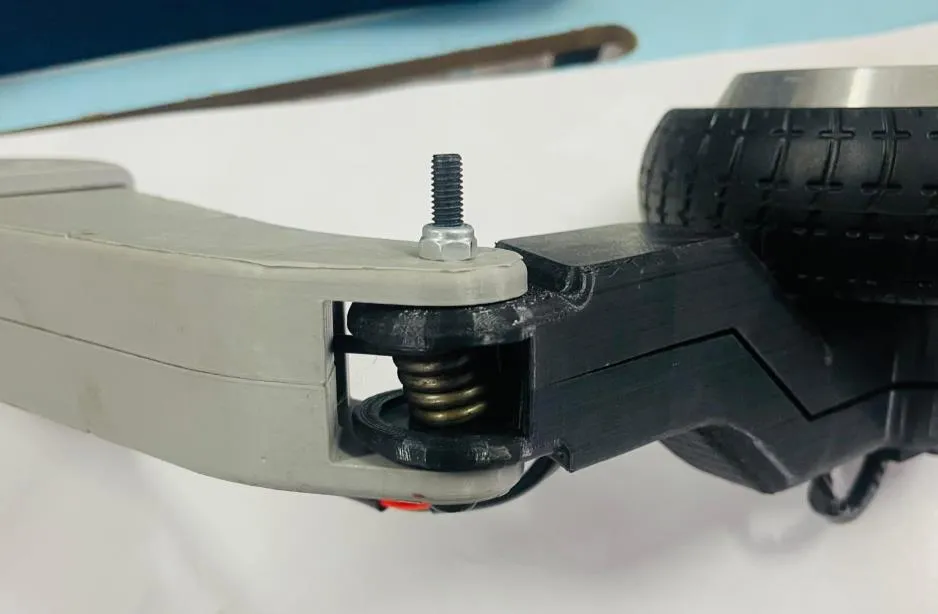
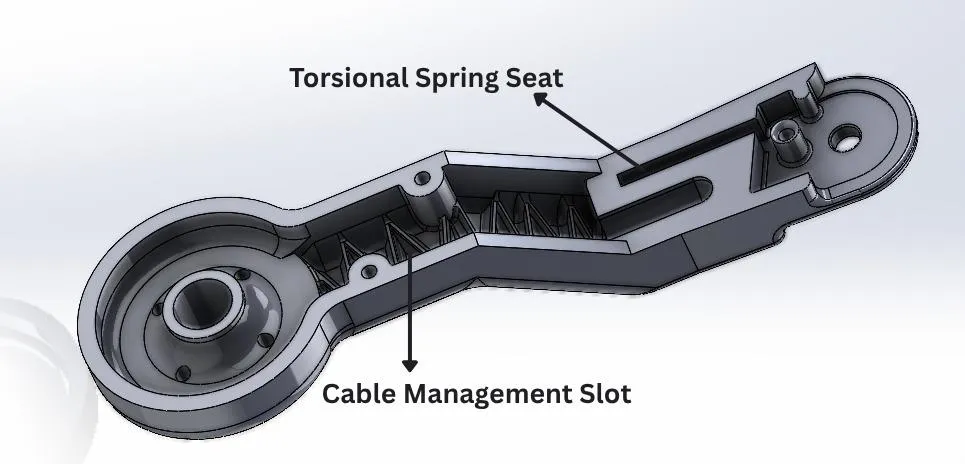
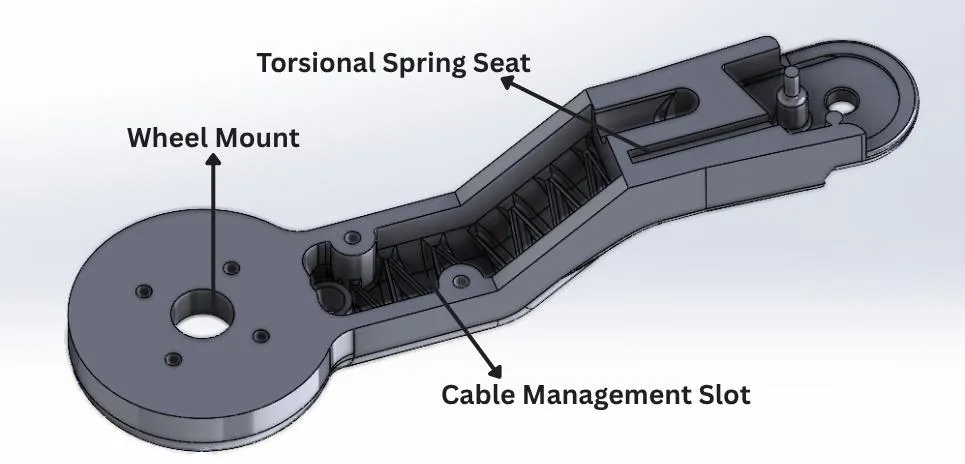
Each planar leg is engineered as a modular three-joint assembly (Hip, Knee, and Foot) with passive compliance and internal routing pathways:
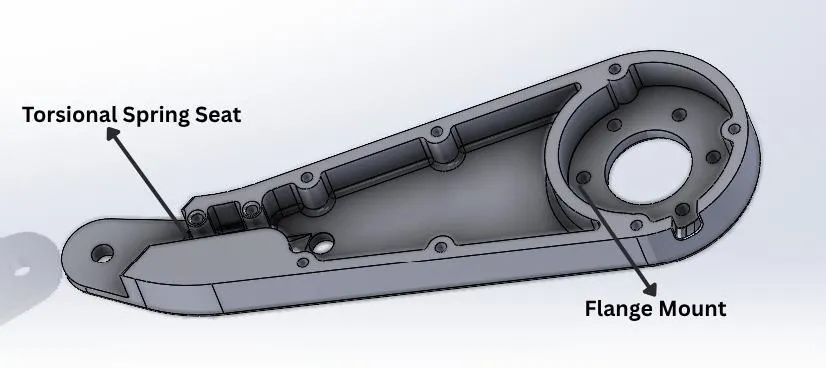
Torsional Spring compliance: A torsional spring joint is embedded in the knee joint housing to act as a passive compliance mechanism, helping to absorb ground vibration and keep traction over uneven profiles.
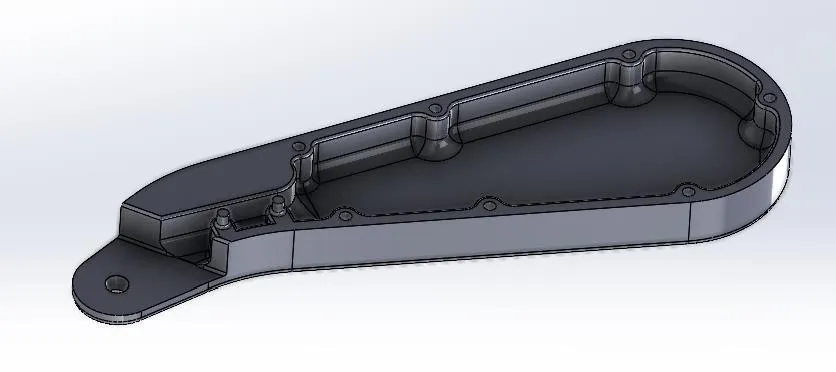
Split-Piece Routing Layout: Thigh and shin segments feature a split-piece layout that allows routing high-current lines and encoder cables internally, protecting wires from exposure and mechanical wear.